what hardware do i need to use mpc software
MPC Renaissance Review: The Hardware
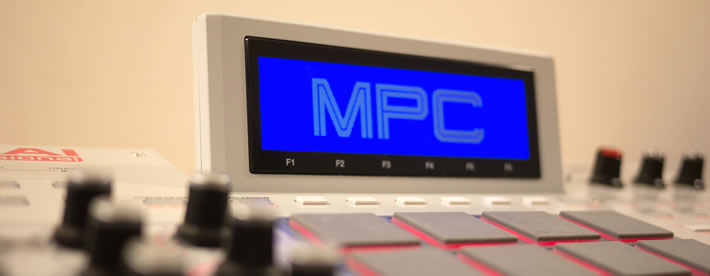
In this MPC Renaissance review, I specifically concentrate on the MPC Renaissance hardware itself, including a expect at build quality, design, features and improvements over previous flagship MPCs.
Pros:
- Solid structure, no creaks, feels quality
- Improved data wheel and buttons
- Built in audio interface negating the need for a separate calculator interface
- Unique hardware and software based vintage mode emulation
- Good feel to pads
Cons:
- But mildly evolutionary from a hardware perspective
- No Q Link sliders
- USB 2.0 rather than USB 3.0
- Only 4 counterpart audio outputs
MPC Renaissance Review: Overall Build & Looks
Upon lifting the MPC Renaissance out of its box, the first impression is that it is a solid, well weighted car. Everything seems to take been built tightly and well put together, and at that place'due south no creaks or loose sections. The top and bottom casing are made of metallic, while the grey sides are a svelte matt rigid plastic. More often than not speaking, the MPC Renaissance certainly has a well built, quality feel most it.
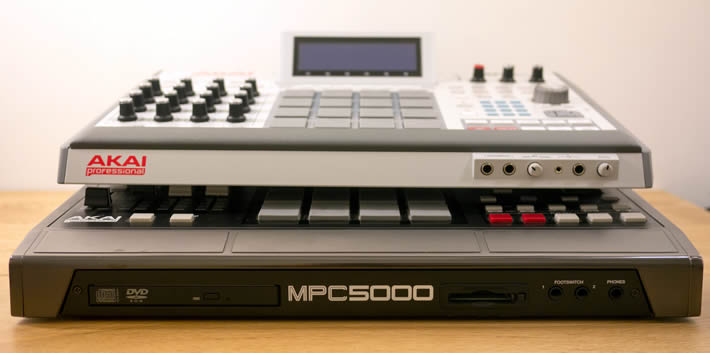
The MPC Renaissance is pretty much the same width equally an MPC5000, merely with the smaller depth of an MPC2500. What makes the Ren very different to previous 'flagship' MPCs is that it has a much lower contour, and this helps information technology move away from the more traditional 'box-like' quality that some MPCs possess. The MPC Renaissance weighs just under 5kg but due in part to that lower profile and the design of the side panels, which have a ridge for your fingers to sit nether, the MPC Renaissance tin can exist carried effectually with a lot less effort than the weight may suggest.
However, I don't think many people are buying the MPC Renaissance with portability in mind; brand no mistake, lugging it effectually in a bag or backpack for extended periods isn't going to exist ideal but for the occasional gig or send to another studio, it's non going to represent any blazon of ordeal. Of course if you demand portability on a regular basis, Akai are clearly hoping you'll prove an eager involvement in the forthcoming MPC Studio.
 The design of the MPC Renaissance is conspicuously heavily inspired by the classic Roger Linn MPC3000, certainly in terms of the overall color scheme, the palm residuum and nigh definitely in terms of the transport buttons (more than about those afterward). This may be seen equally a bit controversial given Roger's contempo comments about his royalty payments, but past all accounts, this was a user requested feature. Putting all that to one side, the pattern every bit a whole is make clean and pleasing and is nearly definitely a big improvement over the somewhat functional design of the MPC5000. But the unabridged production blueprint every bit a whole is really but 'standard MPC' with an MPC3000 skin and no existent surprises (other than the affluence of flashing LEDs everywhere). Don't get me wrong, it's pleasant enough and looks skilful in the studio, but it's non cutting-edge production design, and I for one would similar to meet more than innovation in this aspect of the MPC line.
If the classic MPC3000 look isn't for you, MPC Stuff have already made some MPC Renaissance skins in a multifariousness of colours – including brushed chrome and fifty-fifty a black MPC3000 LE design.
Another legacy MPC-inspired add-on to the Ren is the palm remainder. I assume this is plastic but with a leather await and feel. Information technology's firm with a slight spongy feel and is a nice touch which will give your hands a bit of extra comfort. The arm residue on my unit is a slightly nighttime grey, but there appears to be some units fitted with a black arm remainder.
Audio & MIDI Connections
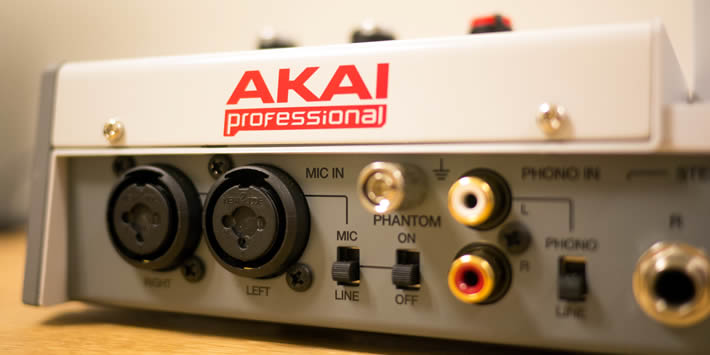
The MPC Renaissance, like all MPCs before it, has the majority of connections at the back of the unit. There's no surprises here, and if you own an MPC5000 most of this will await very familiar. For recording, y'all get two counterbalanced ane/4 XLR inputs that tin be used for line and mic levels (line level is adjusted using switches on the top of the unit), plus dedicated RCA inputs for phono level recordings straight from turntables (grounding screw included). Also included is a phantom power switch for condensor mic recording, and a SPDIF digital in/out.
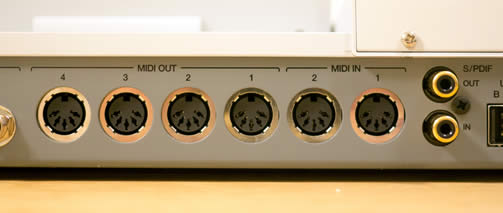
For MIDI, at that place's a 2 IN/iv OUT MIDI interface, which should cover all your MIDI requirements. Not much else I can say most these…
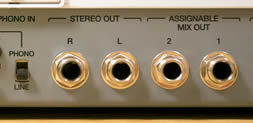
For audio out, there'due south a full of four counterpart ports which use the Ren's built in audio interface to output the sounds from your MPC Software – ports 1 and two are the 'main outputs' and three and 4 are the assignable mix outputs ('individual outs' every bit most MPC users would telephone call them). From within the MPC Software y'all can choose which sounds are sent to which specific output using the program mixer.
These outputs are able to receive the full 'Vintage Fashion' treatment, a combination of software and hardware emulation of the classic sounds of MPC3000, MPC60 and likewise SP1200. I'yard finding it difficult to pin down exactly how Vintage Fashion works and there'southward no detailed caption in the MPC manual, so really we simply accept Akai's marketing machine for the scant information on this procedure, which apparently uses actual circuitry blueprint from the MPC3000 in combination with software algorithms. I'd prefer to spend more fourth dimension with Vintage Mode earlier commenting in detail, and so I'll create a divide review for this characteristic as soon as I can.
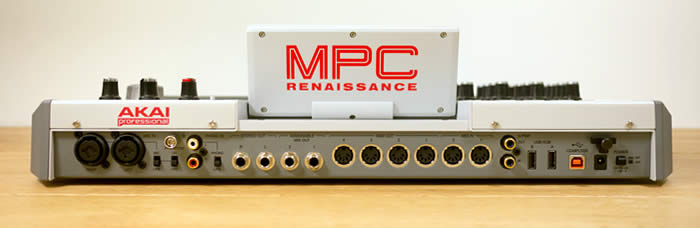
Traditionally a flagship MPC has a total of ten outputs and these are used to 'track' your MPC sequences every bit individual sound tracks to a mixer, DAW or other form of hard disk recorder, assuasive y'all to chop-chop transfer your MPC beats into audio format while taking advantage of external processors, effects or the desired sound of hi finish desks etc. With only four analogue outputs, the Ren is conspicuously at a disadvantage in this respect. Nevertheless it may exist argued that with the motion to a more computer-centric operation, almost of your tracking will be done only past a digital render within the MPC software.
It can as well be pointed out that you are all the same gratis to utilize a tertiary party sound interface (configurable from inside the MPC Software), which could have equally many outputs equally you lot tin afford. Nonetheless both these solutions mean y'all are not able to take full advantage of Vintage Mode, as you tin can only access the software element of Vintage Mode when working exterior of the Ren sound interface. And then either way, information technology's worth begetting this in heed if y'all intend to utilize ten or so outputs from your MPC on a regular basis, especially if you dream of drenching all your individual tracks in total hardware assisted Vintage Style. But again, this really depends if the 'hardware' element of Vintage Style lives upwards to the hype – the feedback on MPC-Forums so far has been fairly subdued.
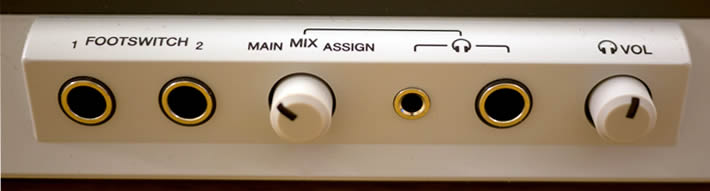
Finally on the front of the machine are two 1/4 inch footswitch ports and two headphone jacks – ane for a 2.5mm connector, one for a 3.5mm. There'southward also a mix control to adjust the mix of MAIN OUT (audio outputs 1 & 2) signal and the 'private outs' bespeak (audio outputs iii and 4).
Figurer Connections
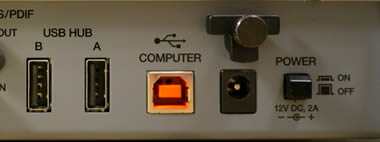 In terms of estimator connectivity, everything is handled by the orangish USB port at the back of the unit; a standard length USB cablevision is included, but you lot should be able to use any decent quality USB cablevision for this connexion. This USB connection is what is used for all advice betwixt the Ren and your computer and must remain continued at all times otherwise the MPC Software will only function correctly. So far I've establish that everything works a lot better if the Ren is connected directly to a primary USB port on your computer, and not via a USB hub (fifty-fifty a powered one). Going through my hub led to a few communication problems which required rebooting both the MPC Software and the Ren. This could even so exist a power issue with my hub.
To recoup the loss of a USB port in your figurer, the back of the Renaissance likewise features a two port USB hub – so far I've connected a ii.5″ portable USB bulldoze into one of these ports and my computer recognised it straight abroad. It's something I'll test more than over time, but and then far, in that location's definitely no obvious power problems here, that drive was working fine.
Unfortunately the entire USB interface uses USB 2.0 rather than the now mature USB 3.0 standard. I'm non certain if this is purely a cost cutting exercise or a limitation of the hardware commuter beingness used to handle the computer connectivity. This still is a mutual trait with the MPC line, for example the MPC1000 used USB ane.i when USB 2.0 was the almost current tech.
Similar the MPC500, the MPC Renaissance runs off an external PSU instead of the usual kettle atomic number 82. This is a 2 function unit consisting of the PSU itself and a detachable two pin lead with the plug on the end. Exist aware that the PSU that ships with the Ren is only approximately iv feet long, so if you need something a little longer you'll need to either use an extension cablevision or purchase an extended length PSU kit from MPC Stuff or other electrical suppliers (make certain you get the correct PSU rating of 12V DC, 2A, heart pivot positive). A handy addition is the power string restraint, which you lot twist your ability cable effectually to help prevent it being accidentally yanked out.
Data Wheel
In my opinion, MPC data wheels take ever been a blot in Numark's copybook, they've either been a bit wobbly and loose, like the MPC1000 and MPC500, or very noisy similar the MPC2500. I'm happy to report that the data wheel on the MPC Renaissance is very dainty indeed, it's sturdy, no major wobble and it more often than not feels good under the fingers. The only minor gripe is that in that location's also no small round indentation to allow easy one-finger scrolling, but this is is not a big deal in general usage equally some of the usual data wheel-heavy jobs are going to be performed in your estimator or via Q Links.
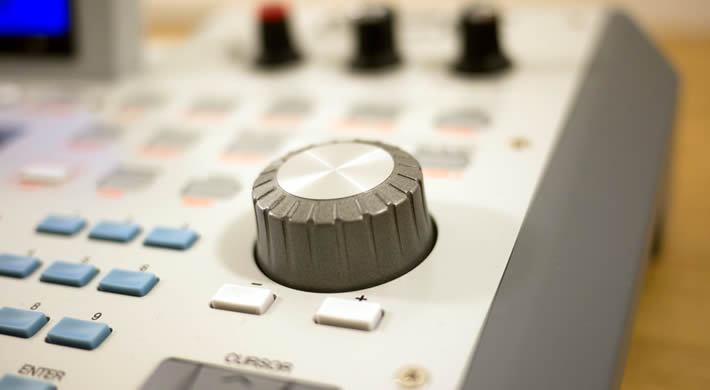
Thankfully this data wheel is very placidity; just a very soft, muffled click that's barely noticeable. So if you're doing late nighttime work at dwelling house, no i is going to be woken by your data wheel (which was definitelynot the case with an MPC2500).
Q Links
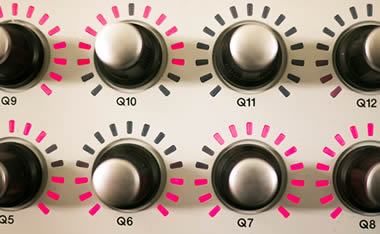 If y'all're new to the MPC and don't know what Q Links are, they are assignable knobs that just let you command MPC Software parameters in real time, such as filter sweeps, tuning changes, sample edits, mixer settings etc. There'south sixteen Q Link dials on the MPC Renaissance and the motion is shine and piece of cake. In operation the dials simply choice up from where the current parameter setting is in the software. And then if Q4 is assigned to the 'tuning' parameter in the software, and the software tuning value is gear up to 87, turning the Q4 punch to the left takes the value from 87 downward. There are no clicks or graduations on the Q Link dials, and no 'aught' indicator. Motion is smooth and there's just enough resistance to give a prissy confident experience to the control.
The dials themselves look similar to the dials used on previous MPCs (minus a zero marker), but this time they take silver painted tops, which I feel look a scrap cheap – a polished metallic top would have been preferable. Nonetheless this painted pinnacle may have been a technical requirement to allow a rather absurd feature of these Q Links – affect sensitivity. This is a feature Akai take kept pretty tranquility about, but basically there are a number of little tricks you lot can practice with this, such as muting tracks or triggering MIDI notes in DAWs, but I'll look at this when I review the software.
Each Q Link punch is surrounded by LEDs which light upwards in succession as you plough the dials – this seems somewhat gimmicky, just nevertheless adds some extra sparkle to a live performance.
An obvious omission are Q Link sliders – the slider is only as much a recognisable feature of legacy MPCs as the pads and data wheel, and then this omission is something I'thousand somewhat bemused past, specially as this is not something they tin can add subsequently via a software update! I retrieve certain Q Link tasks are better suited to a slider, such equally MPC-style scratching, only I appreciate that this is somewhat of a niche use of the MPC, and for nigh tasks y'all'll probably prefer the dial – or at to the lowest degree acquire to adapt your technique pretty apace.
Buttons
There are a vast array of buttons on the tiptop face of the MPC – previous MPC owners volition recognise the majority of them and will soon find that most of the additional buttons are simply dedicated to switching to dissimilar software screens – basically the 'MODE & pad' method has been dropped. People new to the MPC may find all these buttons somewhat intimidating, but really there's nada to worry about and you'll before long be whizzing effectually like an expert.
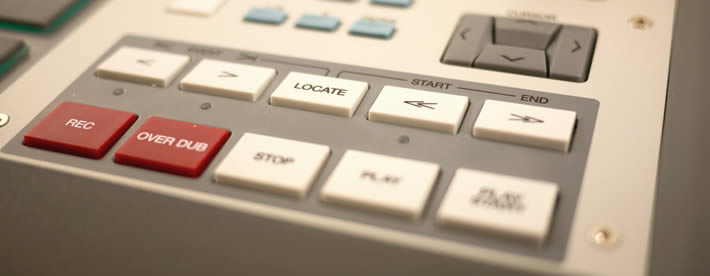
In terms of the hardware used for the buttons, many have been upgraded compared to previous MPCs. For example the transport controls (PLAY, REC etc) are now sturdy, low profile buttons with no wobble – in fact they are identical in looks to the ones used on the MPC3000. This type of depression profile button is now used on the annotation repeat, erase and tap tempo buttons, and even to some degree on the 'cursor' buttons. Function and numeric buttons are also low profile, but with a concave dip – I'k non then sure that the dip provides any existent benefit, and I would have preferred a flat finish, mayhap considering my fingers are fairly large and these dips feel a little uncomfortable. Other than that, all the other buttons are pretty much the standard MPC fair, and are in the mould of the traditional 'PAD Depository financial institution' buttons which illuminate when pressed.
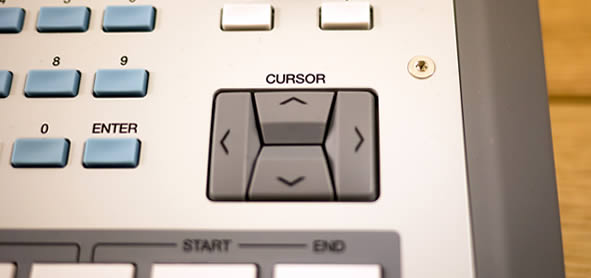
At present, if you've used a previous Numark era MPC, you may have experienced the 'expressionless push' syndrome, where a button requires progressively harder presses until it finally simply stops working. This was really the result of the underlying electronic tact switch failing, and information technology's been suggested that the tacts used in those older MPCs were adequately low quality. And then what about the MPC Renaissance? Well I'chiliad not quite ready to strip information technology down to bank check if the tacts are the same, then just time will tell if they've invested a few extra pennies on some decent tact switches this fourth dimension circular – simply if anyone out in that location fancies opening upwardly the Ren to discover out, transport me the details and I'll update this review with your findings.
In terms of quantity and function, in that location are buttons to control all the major features in the software, either as a dedicated push or accessed via the SHIFT key on the Ren. So for example plan banks A – D accept dedicated buttons, while banking concern Due east is accessed by holding downward SHIFT and pressing the banking company A push. Full LEVEL also has a HALF LEVEL option via the SHIFT key. In that location'due south defended F keys to control functions on the Ren's screen, just like a legacy MPC. Vintage Mode likewise gets its own dedicated push to allow emulation of either MPC60, MPC3000 or the SP1200.
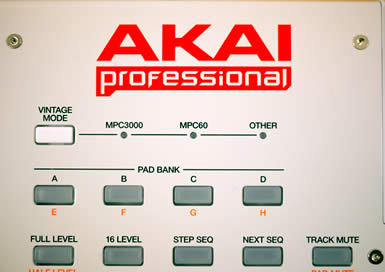
The Pads
No one wants an MPC with nasty pads (ask nearly original blue MPC1000 owners), and quite frankly you should rightly look the pads to be top of the listing of features to become 100% spot on. Well thankfully the pads are absolutely fine – responsive and accurate with a nice easy experience – finger drummers have aught to worry about any, and the pad sensitivity tin be fine tuned through the software then you tin tweak and tweak until yous are 100% happy. I suspect that the general pad and sensor design has been lifted direct from the MPC5000, with ane obvious change – they light upward around the edges.
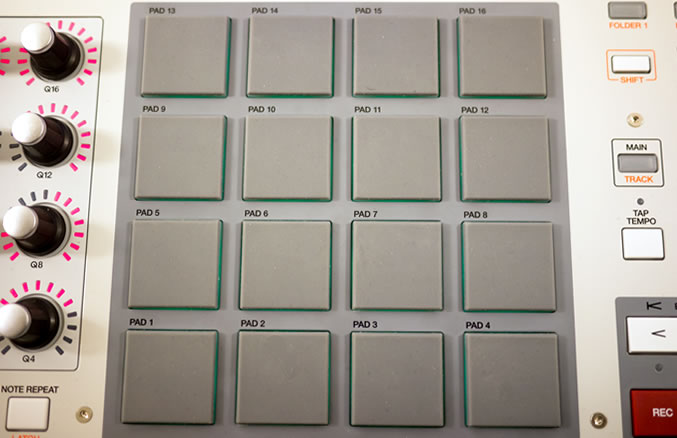
This is accomplished by using transparent prophylactic for the pads while the meridian 2mm of each pad is opaque greyness. By default, the lights indicate how difficult y'all are hitting the pads, so you'll have to decide whether that'southward something you'll benefit from having agile as it can be turned off via the software. Some will see this every bit a gimmick, some volition clearly see the benefits for alive performances – information technology can certainly expect pretty cool in the nighttime, but ultimately it'south currently just eye candy. However perhaps a more useful feature is that can also assign a specific colour to each pad (red, orangish, green or yellow), which could exist used to betoken a certain sample blazon (eastward.g. red=bass, yellow=drums etc).
One thing to point out is that in MPC Software v1.1, rapid hitting of the pads results in approximately ane in half dozen of those hits non lighting up (equally, the pads on the software itself are also exhibiting this upshot). This seems to exist a software bug as v1.0 didn't accept this trouble, so hopefully this tin exist easily fixed. This is not affecting the actual sample playback though, information technology seems purely a visual anomaly.
MPC Renaissance Screen
The MPC Renaissance screen is housed in a hard plastic tilting casing; the housing feels sturdy with no creaks, and can be titled to approximately eighty degrees from the horizontal and as well laid perfectly flat. The motility is smooth rather than the clicking increments you become on older MPCs and there is enough resistance to ensure the screen stays at the bending you want.
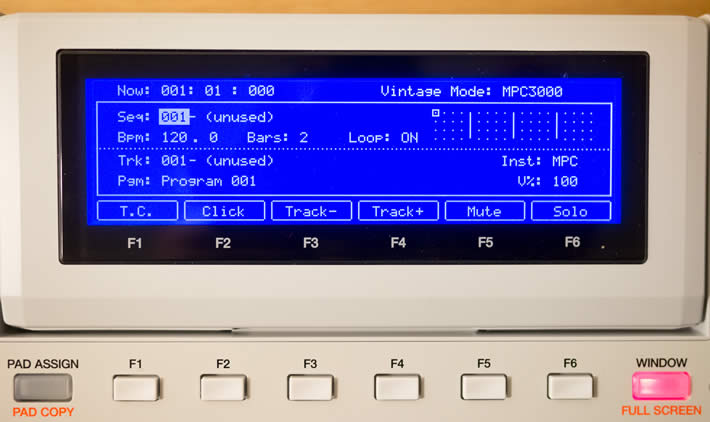
The screen itself is a bright blue LCD brandish that uses the smaller font size you see in JJOSXL. The resolution of the screen is 360 10 96, which is a 50% increase compared to the 240 x 64 LCD used on the MPC2500/1000. Out of the box, the contrast was set perfectly for me, but you tin accommodate the screen contrast to taste within the software (hold downwards SHIFT and turn the information wheel). There is no way to adjust the brightness of the back calorie-free, but in my opinion this doesn't need any aligning, it'southward perfectly fine for all situations.
The brandish is crisp, and like shooting fish in a barrel to read even when continuing. The just result for me is that this LCD exhibits a slight visual 'fade' when you movement from one screen to another. When I commencement saw this I was disappointed as I adopt an instantaneous change like it is on an MPC2500, but to be perfectly honest I've now got used to this – still, unless this is a hardware limitation, information technology would be nice to be able to turn this off in the software. I've seen people refer to this every bit 'lag', but in all fairness there is no actual lag – printing a button to modify screen and the screen alter begins immediately. Merely the change itself is done with a fading transition.
Mods & Add-Ons
At the time of writing it seems merely MPC Stuff is making mods and add-ons designed specifically for the MPC Renaissance. As I've already mentioned, they take several different adhesive skins to completely change the colour scheme, and also have replacement side panels made out of stained hardwoods. I have a set of the oak sides, although I've not had the time to install yet:
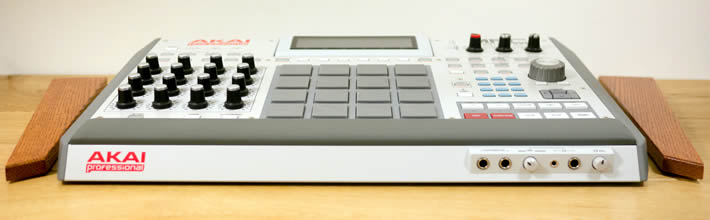
There'south likewise a matching wooden palm rest. MPC Stuff tell me that on the way are thick pads (which I assume will illuminate), coloured standard size pads, coloured palm rests and black button sets. In addition to these in that location are a number of other parts and accessories bachelor that are compatible with the Ren.I will keep my centre out for other MPC Renaissance add-ons – if you see any, please let me know in the comments.
Decision
The MPC Renaissance hardware is definitely well made with a skilful solid, creak-gratis build quality. There's welcome improvements to the MPC data wheel and buttons, the pads are excellent and excepting the love-detest fade transitions, the screen is crisp, vivid and clear. Other than that, everything is generally 'as expected' of a hardware MPC.
I would have liked to have seen the inclusion of at least 1 trusty Q link slider, fifty-fifty if this was at the expense of a column of Q Link dials, and I doubtable the lack of counterpart outputs will disappoint some. Equally always, I'm bemused past Akai's use of conspicuously outdated tech such as USB 2.0 in a earth where USB iii.0 is starting to show its age .
Just every bit a whole, the MPC Renaissance seems fine to perform the job it was built for – to command the new MPC Software, and it'due south this software that quite rightly is getting most of the attention. Only taking a step back from the whole 'Maschine-esque' model Akai have now adopted, how far has Akai brought the hardware aspect of the MPC since the previous flagship, the MPC5000? Can the hardware on its own be referred to as 'revolutionary'? Well, features such as the bear on sensitive Q Links, illuminated pads and the hardware/software based Vintage Fashion are clearly 'evolutionary' but you'd be struggling to refer to these additions on their own equally 'game changing' or truly innovative – in my opinion these are welcome but ultimately incremental improvements and tweaks to the core MPC pattern.
To be off-white, conspicuously Akai's main focus has been the software, and I doubtable this will continue to be their main focus for some fourth dimension. I assume the chief goal when building the Ren hardware was to create something functional, reliable and fit for purpose, and the near cost effective way to practise this was to use tried and trusted features from the previous MPCs. And if truth be told, I call up nigh of us would rather Akai put nearly of their resource into ensuring the MPC Software was stable and well-featured from the get-become rather than try to simulataneously juggle a huge software projectand a groundbreaking piece of hardware.
Just how long tin can the 'tried and trusted' MPC hardware survive in a rapidly changing market with ever-increasing contest from the likes of Native Instruments? Software innovation is important, but equally applied science moves on, surely there'south plenty of room for workflow improvements fabricated directly from the hardware itself? With the iPad powered MPC Fly on its way, I can't assist but wonder how much hardware MPC workflow could be transformed past the introduction of a built in touch screen, with for example pinch and zoom sample editing and replacement of the traditional button pushing in favour of multitouch gestures. I can't be the only person who wonders what an MPC would look like if some of the Apple production designers got their easily on it.
But in the meantime, the MPC Renaissance hardware certainly seems capable of handling the duties required of it. In my next MPC Renaissance review I'1000 going to take a look at the main features of the MPC software (both on the reckoner and the firmware Bone within the hardware), just most chiefly I'm going to make a detailed cess every bit to how the shift to a software-controller model has impacted the classic MPC workflow.
MPC Renaissance Tutorials
If you lot are looking for MPC Renaissance and MPC Studio tutorials, I've written two books packed out with tutorials, tricks and essential shortcuts for the MPC Software; 'The MPC Renaissance & MPC Studio Bible (for MPC Software 2.x), and 'MPC Renaissance & MPC Studio: Sampling Laid Bare' (for MPC Software 1.ix.6).
Source: https://www.mpc-tutor.com/mpc-renaissance-review-hardware/
0 Response to "what hardware do i need to use mpc software"
Post a Comment